
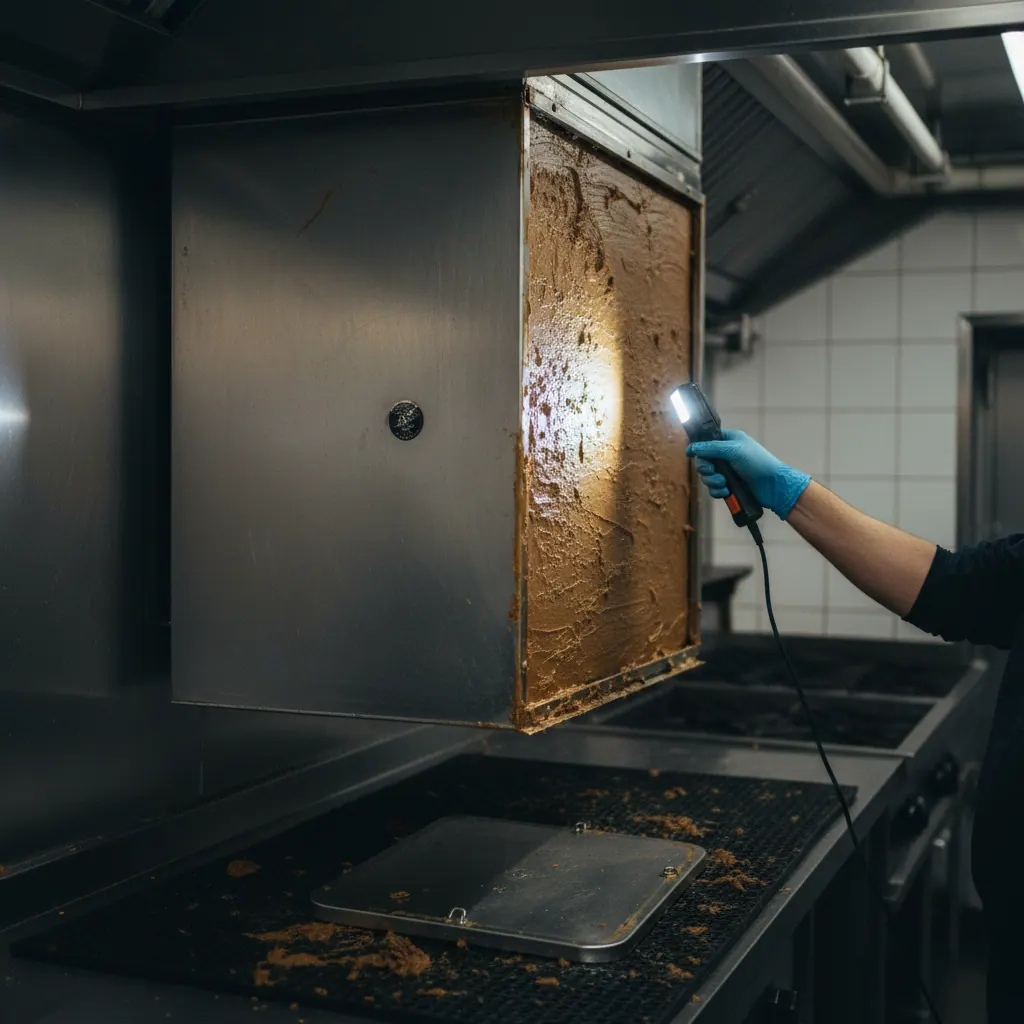
Kitchen extract cleaning in City of London
Kitchen extract cleaning in City of London runs to the same TR19 and EHO-aligned standard as our central London work — adapted to the local kitchen estate. The Square Mile runs Monday-to-Friday lunch service at unmatched intensity — corporate dining rooms, members' clubs and broker-class restaurants service four-figure covers in a six-hour window before going quiet over the weekend. Our City of London schedule centres on leadenhall market fine-dining and corporate dining rooms and the cluster of bishopsgate and liverpool street corporate hospitality nearby.


Why City of London kitchens need extract cleaning
Mostly corporate dining and members' clubs — small kitchens producing large lunch volumes (200–800 covers, 11:30–14:30) then dormant. Many sit in listed buildings with constrained extract runs and difficult after-hours access. The City of London Corporation runs its own EHO team, separate from inner-London boroughs. Inspections are notably more frequent than outer boroughs — EC1–EC4 venues report visits every 12–18 months versus 24–36 months elsewhere. Scoring is rigorous on structural cleanliness given the age of the kitchen estate. This drives a specific approach to extract cleaning in City of London — the schedule, the chemistry, and the documentation all need to fit the local estate and the local inspection pattern.
City of London venue clusters we cover
We work across the major City of London hospitality clusters: leadenhall market fine-dining and corporate dining rooms; bishopsgate and liverpool street corporate hospitality; cheapside and bow lane lunch-focused restaurants; smithfield-adjacent meat-market-trade restaurants. TR19 compliance in the City is not optional — EHO inspectors and corporate-property insurers both audit aggressively here. Most City clients run quarterly TR19 cleans rather than annual.
Access and out-of-hours work in City of London
Out-of-hours access typically through Cheapside-, Bishopsgate- or Cannon-Street-side service lifts. Security passes required for most addresses; we hold pre-approved supplier accounts at the major property-management groups. For extract cleaning specifically, we usually schedule City of London work in the standard out-of-hours window — kitchens are dry and ready for morning prep.
Kitchen extract cleaning in City of London
- ✓Canopy underside, baffle filters and plenum chamber cleaned
- ✓Vertical and horizontal ductwork accessed and cleaned along its full length
- ✓Roof-mounted or in-line extract fan blade and housing cleaned
- ✓Pre- and post-clean photographic evidence at every access point
- ✓Wet film thickness (WFT) grease measurements before and after
- ✓Post-clean certificate aligned to the BESA TR19 grease specification
- ✓Access panels installed if missing (priced separately on quote)
From enquiry to sign-off.
- 1. Site survey
We inspect the system from canopy to fan, identify all access points, and flag any panels that need installing for full coverage. Quote within 48 hours.
- 2. Overnight clean
Our TR19-trained engineers work through the system overnight — mechanical agitation, chemical degreasing and manual brushing through every section.
- 3. Certificate and report
You receive a dated certificate, before/after photographs at every access point, and WFT measurements as evidence for your insurer.
£895–£2,800+ outside London · £1,195–£3,500+ in London · Small system (café/pub) from £895 (£1,195 London); medium system (restaurant) from £1,495 (£1,895 London); large system (hotel/multi-kitchen) from £2,800 (£3,500 London). Quoted by ductwork length, vertical risers, fan access and access panel count after a 30-minute site survey.
Prices shown exclude VAT. London rates apply within the M25. All other UK cities use standard rates.
Get a fixed-price quote for City of LondonCity of London — coverage map
Extract cleaning in City of London — questions
Do you cover all of City of London? +
Yes — we cover every postcode in City of London, including the major clusters: Leadenhall Market fine-dining and corporate dining rooms and Bishopsgate and Liverpool Street corporate hospitality. Out-of-hours access patterns vary by cluster; we coordinate access ahead of every visit.
What does extract cleaning cost in City of London? +
£895–£2,800+ outside London · £1,195–£3,500+ in London. City of London kitchens trend toward mostly corporate dining and members' clubs — small kitchens producing large lunch volumes (200–800 covers, 11:30–14:30) then dormant — we factor that into the quote at site walk.
Which EHO covers City of London? +
The City of London Corporation runs its own EHO team, separate from inner-London boroughs. Inspections are notably more frequent than outer boroughs — EC1–EC4 venues report visits every 12–18 months versus 24–36 months elsewhere. Scoring is rigorous on structural cleanliness given the age of the kitchen estate.
How is extract cleaning different from canopy cleaning? +
Canopy cleaning covers the visible hood and baffle filters only. Extract cleaning covers the whole system — canopy plus ductwork plus fan. Insurers require the full system cleaned to TR19 specification, not just the canopy.
How often should the extract system be cleaned? +
BESA TR19 sets frequency by usage: heavy use (12+ hours/day) — every 3 months; moderate (6–12 hours/day) — every 6 months; light (<6 hours/day) — every 12 months.
What is a wet film thickness reading? +
A WFT gauge measures the depth of grease residue on the duct interior in microns. TR19 sets thresholds: below 200μm is acceptable; above is non-compliant. We measure before and after and include both in your report.
Get a same-day quote for the City
Extract cleaning across City of London and the wider London region. Same-day quotes, most jobs within 48 hours.