TR19 cleaning in Liverpool
TR19 cleaning in Liverpool runs to the same TR19 and EHO-aligned standard as our central London work — adapted to the local kitchen estate. A waterfront restaurant city built around two distinct cores: tourist-led harbourside dining at Albert Dock, and the independent-restaurant density of Bold Street — named the UK's best independent restaurant street in recent industry coverage. Our Liverpool schedule centres on bold street and berry street independent restaurant strip and the cluster of albert dock and royal albert dock waterfront tourist dining nearby.


Why Liverpool kitchens need tr19 cleaning
Bold Street operates 40+ restaurants in a half-mile strip — predominantly small kitchens (40–80 covers) in retrofitted Victorian/Georgian buildings with shared extract risers. Albert Dock venues sit inside Grade I listed warehouses, with extract running through original brick risers under heritage constraint. Baltic Triangle is converted-warehouse modern conversion. Liverpool City Council Environmental Health covers the city; Sefton and Wirral MBCs cover the outer Merseyside boroughs. Inspection focus on Bold Street and the Baltic Triangle has intensified since 2022 as the venue density on those streets increased — expect 12–18 month cycles in those clusters versus 24–36 elsewhere. This drives a specific approach to tr19 cleaning in Liverpool — the schedule, the chemistry, and the documentation all need to fit the local estate and the local inspection pattern.
Liverpool venue clusters we cover
We work across the major Liverpool hospitality clusters: bold street and berry street independent restaurant strip; albert dock and royal albert dock waterfront tourist dining; baltic triangle creative-quarter independents; castle street and exchange flags corporate and high-end. Liverpool waterfront venues face stronger gull-pressure and salt-air corrosion than inland sites — extract grease accumulation runs faster, and stainless steelwork degrades quicker. Most Albert Dock and waterfront operators run 6-monthly TR19 cycles rather than annual.
Access and out-of-hours work in Liverpool
Out-of-hours access via the M62 and Kingsway tunnel. Bold Street is pedestrianised — TR19 vehicles need permits via Liverpool City Council's Highways team and time-windowed access. Albert Dock has dedicated service routes off Strand Street. For tr19 cleaning specifically, we usually schedule Liverpool work in the standard out-of-hours window — kitchens are dry and ready for morning prep.
TR19 cleaning
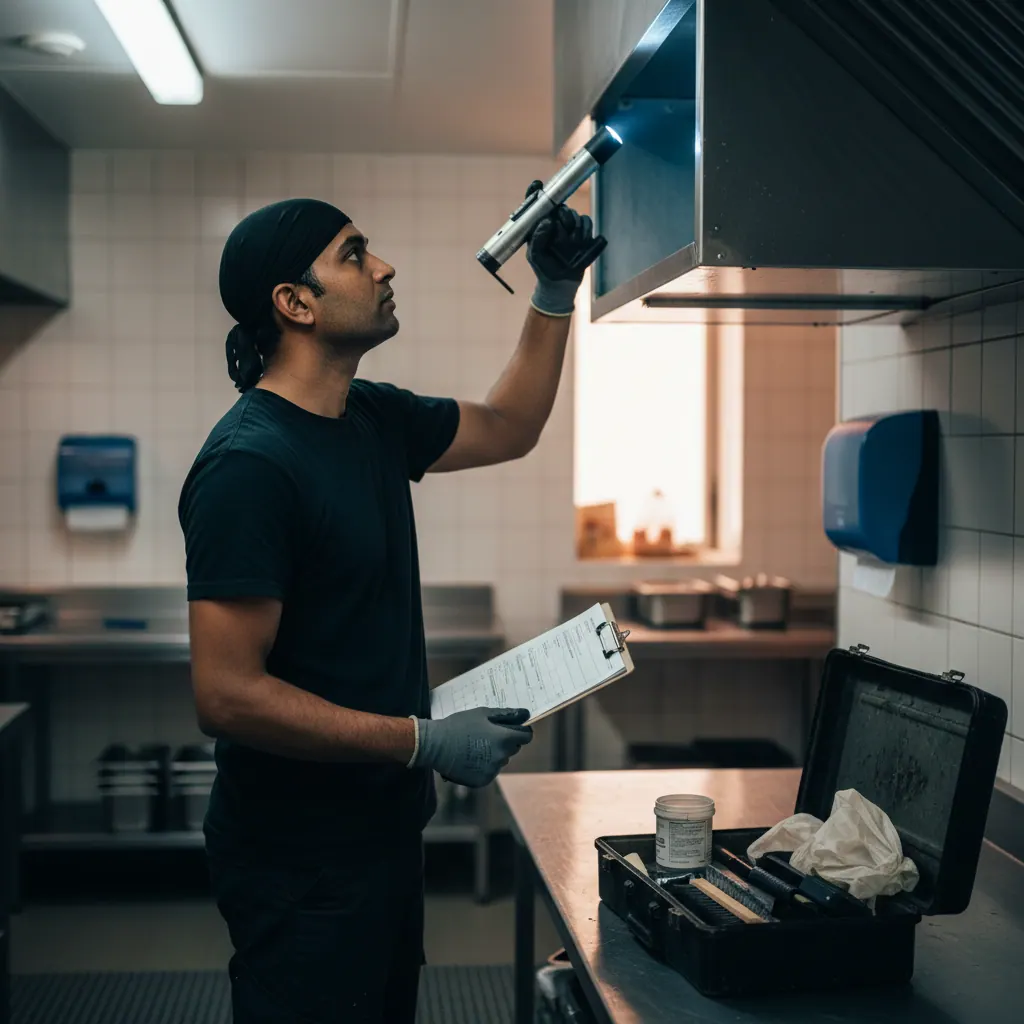
- ✓Pre-clean wet film thickness (WFT) survey at every access point
- ✓Mechanical and manual cleaning of ductwork along its full length
- ✓Canopy, plenum, baffle filters, ductwork interior and extract fan all cleaned
- ✓Post-clean WFT readings — target below 200μm per the TR19 grease specification
- ✓Dated photographic evidence at every access point, before and after
- ✓TR19-aligned post-clean certificate with system schematic
- ✓Recommendation for next clean date based on observed grease deposition rate
From enquiry to sign-off.
- 1. Survey and WFT readings
A 60–90 minute survey at your kitchen — we identify every access point, take WFT readings, and confirm whether the system is currently compliant. Fixed-price quote within 24 hours.
- 2. Clean to spec
Overnight or shutdown-day. Our BESA-aware engineers work the system end to end — chemical, mechanical, manual — through every section.
- 3. Certificate and photo report
Within 48 hours you have a digital certificate, system schematic, dated photo log and WFT readings. Designed for direct submission to your insurer.
£895–£2,800+ outside London · £1,195–£3,500+ in London · Small system (café/pub) from £895 (£1,195 London); medium system (restaurant) from £1,495 (£1,895 London); large system (hotel/multi-kitchen) from £2,800 (£3,500 London). Quoted by ductwork length, riser count, fan access and access panel availability.
Prices shown exclude VAT. London rates apply within the M25. All other UK cities use standard rates.
Get a quote for LiverpoolTR19 cleaning in Liverpool — questions
Do you cover all of Liverpool? +
Yes — we cover every postcode in Liverpool, including the major clusters: Bold Street and Berry Street independent restaurant strip and Albert Dock and Royal Albert Dock waterfront tourist dining. Out-of-hours access patterns vary by cluster; we coordinate access ahead of every visit.
What does tr19 cleaning cost in Liverpool? +
£895–£2,800+ outside London · £1,195–£3,500+ in London. Liverpool kitchens trend toward bold street operates 40+ restaurants in a half-mile strip — predominantly small kitchens (40–80 covers) in retrofitted victorian/georgian buildings with shared extract risers — we factor that into the quote at site walk.
Which EHO covers Liverpool? +
Liverpool City Council Environmental Health covers the city; Sefton and Wirral MBCs cover the outer Merseyside boroughs. Inspection focus on Bold Street and the Baltic Triangle has intensified since 2022 as the venue density on those streets increased — expect 12–18 month cycles in those clusters versus 24–36 elsewhere.
What does TR19 actually require? +
TR19 (current edition: TR19 Grease, 2019) requires the entire extract system to be cleaned to a defined grease level (below 200μm WFT), with documentary evidence and a certificate produced after each clean. Frequency is set by usage hours.
Is TR19 a legal requirement? +
TR19 itself is a technical specification, not a statute. But the Regulatory Reform (Fire Safety) Order 2005 places a legal duty on the responsible person to manage fire risk — and TR19 is the recognised industry standard for evidencing that the extract system is not a fire risk.
Will my insurance pay out without a TR19 certificate? +
It depends on the policy wording. Most commercial kitchen insurance policies now reference TR19 (or the BESA grease specification) directly. Without a current certificate, claims for kitchen fire damage are routinely refused or reduced.
Get a same-day quote for Liverpool
TR19 cleaning across Liverpool. Same-day quotes, scheduled within 48 hours.