
Why Hotel Restaurants Fail (Even in 5-Star Hotels)
Discover why hotel restaurants fail even in 5-star properties with high occupancy. This guide breaks down the thin hotel restaurant profit margins (often 3–10%), heavy cost structures, and the "diluted identity" trap. Learn how to transform an internal amenity into a destination venue by mastering local marketing, consistent kitchen operations, and emotional atmosphere to stop unrealized revenue leaks.
Mr Kitchen Porter
3/28/20267 min read
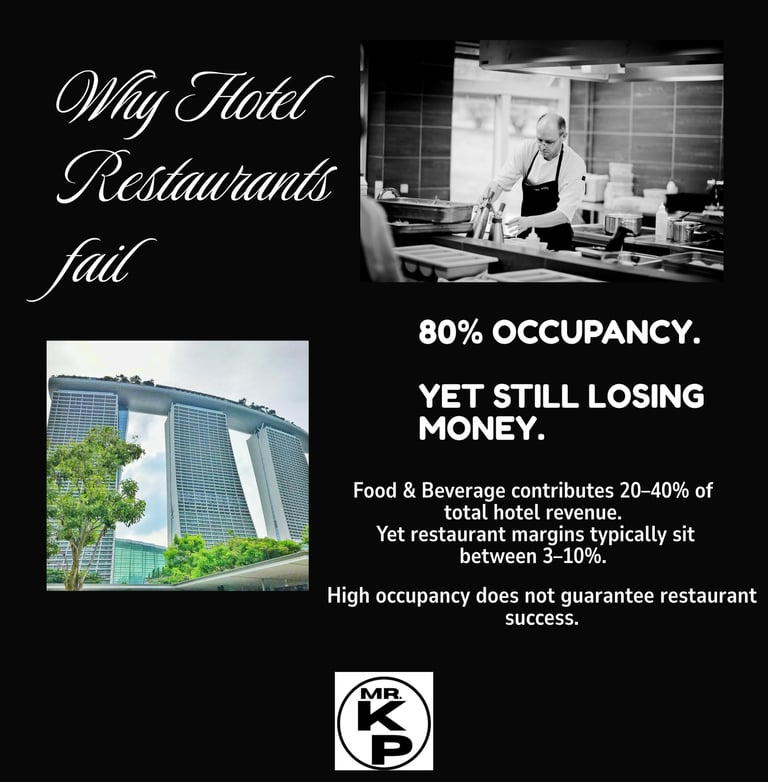
A hotel can run at 80% occupancy and still have a restaurant that bleeds money.
It happens more often than most operators admit.
Globally, food and beverage (F&B) contributes roughly 20–40% of total hotel revenue, depending on the property type. Yet margins are thin. Industry benchmarks often place restaurant profit margins between 3–10%, compared to higher-margin rooms revenue.
So despite premium branding, five-star positioning, and strong room occupancy, hotel restaurants freqently underperform relative to the rest of the property.
So why do hotel restaurants fail — even when the rooms are selling?
Let’s break it down properly.
The Revenue Assumption That Fails
Running a restaurant inside a hotel is not the same as running a hotel. Food hospitality is chef-led, performance-driven, and built on constant menu evolution, guest engagement, and operational precision. It is about creating a venue that competes in the open market, attracts locals, and delivers profit daily.
Hotel hospitality, on the other hand, is broader in scope and focused on rooms, brand consistency, and multi-department service delivery. The thinking process of a restaurateur or chef is fundamentally different from that of a hotel general manager.
Those operating mindsets are fundamentally different.
According to industry research, only a minority of hotel bookings are influenced by an on-site restaurant, with the quality of the room and location carrying far greater weight. An article by a UK-focused trade publication Eat.Drink.Sleep bears evidence to this.
Many hotel operators assume otherwise and this often leads to a decline in expected revenue.
But real-world behaviour shows:
Business travellers expense external dining for networking
Tourists actively seek local recommendations
Younger guests prioritise “discovering” neighbourhood venues
In many cases, a very small percentage of residents choose the hotel restaurant for dinner.
Let’s take for example: If average spend per diner is £45 and 100 potential diners are lost nightly to local competitors, that is:
£4,500 per night
Over £1.6 million annually in unrealised revenue
Diluted Identity
In modern hotel restaurants, there is so much branding confusion.
Too many hotel restaurants attempt to serve:
Breakfast for residents
Casual lunch for tourists
Fine dining for locals
Corporate dinners
Room service overflow
In dense urban market, being generic is fatal. Research across hospitality marketing consistently shows that restaurants with a clearly defined cuisine and identity outperform “all-day dining” formats in average spend per head. Source: https://clfi.co.uk/resources/restaurant-profit-margins/
The restaurant is basically unclear about who they serve, what they specialise in and why they are different.
Branding Confusion kills momentum, and a steady decline in momentum makes business success feels vague.
Cost Structures Are Heavier Than Operators Admit
Hotel restaurants carry hidden drag.
They often service:
Breakfast buffet
Room service
Banquets
Conference catering
Bar operations
Each layer adds staffing complexity and waste exposure.
Benchmarking from major hospitality advisory firms suggests healthy food cost should sit between 28–35% of revenue. Yet buffet-driven or multi-format hotel restaurants frequently drift higher due to spoilage, overproduction, and unpredictable demand curves.
Labour is the bigger pressure point.
Post-pandemic wage increases across Europe have pushed hospitality labour ratios upward. With profit margins already in single digits (as cited by the National Restaurant Association), even a 3–4% labour overrun can erase net profit entirely.
A standalone restaurant can trim menus, cut service periods, or re-engineer hours quickly.
A hotel restaurant often cannot — because breakfast must run, room service must exist, and events must be staffed.
Flexibility disappears.
Margins follow.
They Ignore the Local Market
In bustling, competitive areas like Shoreditch in London or the beautiful backdrop of Paris, diners have endless options to choose from. The rise of food delivery services and online reviews has only amplified this. Whether it’s a trendy pop-up, a specialist ethnic eatery, or a chain restaurant with massive marketing budgets, these areas are saturated with choices.
If your hotel restaurant’s menu is generic—“continental fusion,” “international cuisine,” or “all-day dining”—you’re fighting an uphill battle. Generic concepts just don’t resonate with the growing demand for unique, authentic, or niche dining experiences. This is especially true in cosmopolitan markets where consumers are increasingly looking for novelty, quality, and originality. The hospitality industry research firm STR (2022) notes that hotel restaurants in high-traffic urban centers often struggle when their offerings don’t stand out from the crowd.
In these areas, you’re not just competing with other hotels. You’re up against:
Specialists: Local chefs who have built reputations around a specific cuisine or cooking style, offering authentic and high-quality food.
Trend-Led Independents: Hip, independently-owned restaurants that often capitalize on the latest food trends or sustainable dining practices. For example, plant-based restaurants or farm-to-table dining have boomed over the past few years, especially in urban centers.
Aggressively Marketed Chains: Major chains, which can offer consistency and lower prices thanks to economies of scale. Brands like Shake Shack have strong local followings and significant marketing budgets to ensure they dominate online and offline visibility.
When hotel restaurants serve up “safe,” they are easily outpaced by these dynamic, niche competitors. Local diners aren’t just looking for a meal; they’re looking for an experience, a reflection of their values, or a memorable night out. A recent Restaurant Business report (2021) revealed that 63% of consumers are willing to pay a premium for restaurants that reflect local culture, sustainability, or innovation.
Failure Trigger: No Compelling Reason for Locals to Choose You
Without a compelling reason to visit, local patrons will keep walking past the hotel’s front doors. If the menu doesn’t excite or provide value, or if it fails to incorporate local flavors, trends, and preferences, the restaurant risks becoming an afterthought—especially in cities with a vibrant and diverse dining scene. Hotel restaurants often fall into the trap of relying too heavily on hotel guests, neglecting the broader local customer base that keeps the area alive.
If hotel restaurants don’t cater to local tastes, seasonal trends, or the community’s dining preferences, they risk losing loyal customers and falling behind more flexible, creative competitors.
Atmosphere Is an Afterthought
In today’s post-2020 dining culture, people don’t just eat out, they experience dining. The act of dining has become intertwined with social media culture. Diners are no longer simply savoring a meal; they are also:
Filming every dish
Posting their meals to Instagram or TikTok
Reviewing their experiences on platforms like Yelp or Google
Sharing their experiences with friends and followers
A 2019 study found that ambiance was one of the top drivers for repeat visits, with 72% of diners saying that the atmosphere of a restaurant played a crucial role in their decision to return and tell people about the experience. This trend has only intensified post-pandemic, as dining has become as much about the environment as the food itself.
Yet many hotel restaurants fall short when it comes to creating a memorable atmosphere. Too often, these spaces are designed with a “corporate” mindset rather than a hospitality-focused one. Hotel restaurants often feature:
Cold, corporate lighting that creates a sterile, unwelcoming vibe
Lack of music identity, leading to a lifeless, flat atmosphere
Transitional design, meaning the space feels more like a hallway or a waiting room than a place to relax and enjoy a meal
As Restaurant Hospitality (2021) notes, dwell time—how long diners spend in a restaurant—is directly correlated with how much they spend. The longer customers stay in a comfortable, inviting space, the more likely they are to order additional drinks, desserts, or even return for future visits.
When a hotel restaurant’s atmosphere feels like a sterile, unmemorable space (think: a waiting room for elevators or conference rooms), diners won’t linger. They’ll eat quickly and leave. They won’t engage with the environment, share their experience online, or recommend the spot to friends.
Failure Trigger: No Emotional Pull
Without creating an atmosphere that draws guests in emotionally, hotel restaurants miss out on key opportunities to build loyalty and connection with their diners. In fact, according to a report from The National Restaurant Association (2021), 50% of consumers say they will return to a restaurant if it offers a unique and inviting atmosphere, while only 32% say food alone is the deciding factor for repeat visits.
In competitive markets, where diners have endless options, offering more than just good food—creating a space that evokes emotion, encourages lingering, and feels “Instagram-worthy”—is a necessity. A hotel restaurant that ignores ambiance is simply leaving money on the table.
The Local Test
Ask yourself honestly: If this restaurant weren’t attached to a hotel, would local residents book it? Would it generate independent reviews? Would it attract repeat customers?
If you can’t confidently answer “yes” to these questions, then the issue likely isn’t the décor or the layout. It’s positioning.
Hotel restaurants that succeed treat themselves as destination venues, not just internal amenities for hotel guests. Simply offering good food in a hotel isn’t enough to guarantee long-term success. In fact, many hotel restaurants fail because they rely too heavily on the influx of transient hotel guests, ignoring the much larger and more lucrative local market.
Successful hotel restaurants invest in:
Clear Brand Identity: Just like any successful restaurant, a hotel restaurant must have a distinct identity. This goes beyond just having a recognisable logo—it means defining what the restaurant stands for, the type of cuisine it serves, and the experience it offers. According to a Deloitte study (2020), restaurants with strong brand identities have a 30% higher chance of customer loyalty. Hotel restaurants that position themselves as true dining destinations attract locals and visitors alike because people are drawn to unique concepts.
Consistent Kitchen Operations: No amount of ambiance or marketing can make up for inconsistent food quality. Successful hotel restaurants invest heavily in kitchen operations and training staff to deliver a consistent, high-quality product every time. The National Restaurant Association (2020) found that food quality and consistency are the top factors that influence repeat visits, surpassing even service quality. If the food is good and reliable, diners will return. If it’s unpredictable, they won’t.
Local Marketing Strategy: You can’t expect locals to magically discover your restaurant just because it’s part of a hotel. Effective marketing, especially local outreach, is essential for building a strong customer base. This includes leveraging social media, hosting local events, engaging with nearby businesses, and offering promotions tailored to the local community. A 2025 article by cropink showed that social platforms now guide dining choices for 74% of consumers, making them the leading source of restaurant inspiration
Strong Back-of-House Structure: Behind every successful restaurant is a strong, efficient back-of-house operation. This includes well-organised kitchen teams, clear communication channels, and an effective supply chain. Hotel restaurants often struggle with operational inefficiencies due to their large size or complex menu offerings. A streamlined, well-managed kitchen can avoid common pitfalls like waste, overproduction, and inconsistent service—issues that directly affect the customer experience.
By focusing on these four pillars—brand identity, kitchen consistency, local marketing, and efficient operations—hotel restaurants can carve out a niche for themselves in the local dining scene, attracting repeat customers and generating independent reviews. A hotel restaurant should never rely solely on hotel guests to fill its tables; it needs to be a destination that locals are proud to visit regularly.
WORKING HOURS
Monday - Friday 08:00 AM - 6:00 PM
Sunday - Saturday 09:00 AM - 5:00 PM
Mr. Kitchen Porter and the Mr Kitchen Porter Logo are registered trademarks of Elevation Support Services Limited
ADDRESS
2nd floor Berkeley Square House Mayfair W1J 6BD London
Head office: Cremer Business Centre, 37 Cremer street, E2 8HD, London UK
020 3960 5996
hello@mrkitchenporter.com