
Michelin Star Restaurant Training Secrets | What you can steal
You don’t need a Michelin star to train like you’re aiming for one. Discover 6 "stealable" habits from world-class kitchens like Gordon Ramsay and Noma—from building a Kitchen Standard Operating Procedure (SOP) to mastering the 5-minute pre-service briefing. Learn Michelin Star Restaurant Training
Mr Kitchen Porter
4/4/202610 min read
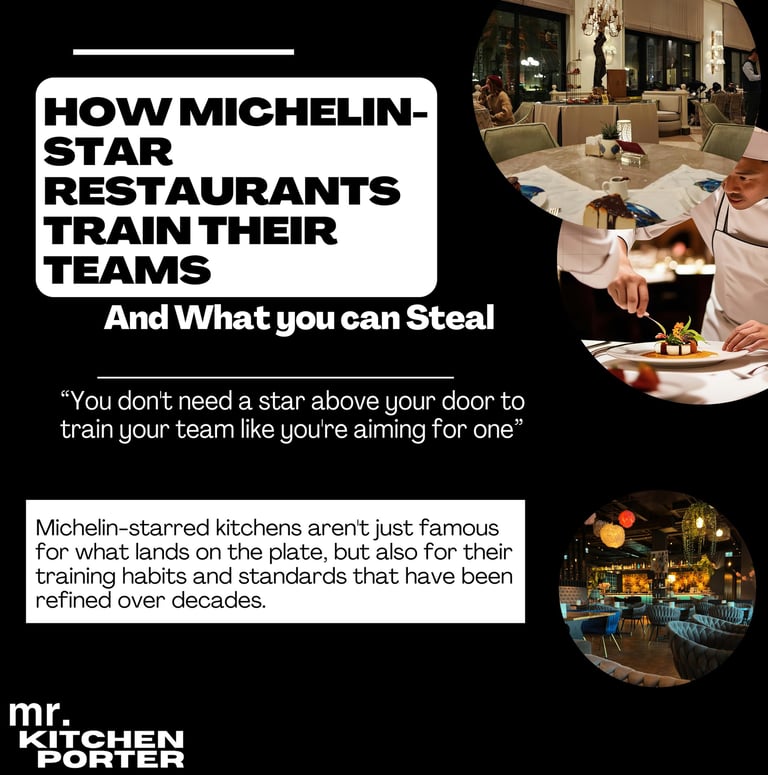
You don’t need a star above your door to train your team like you’re aiming for one. That’s the core idea behind this article. Michelin-starred kitchens aren’t just famous for what lands on the plate — they are among the most disciplined workplaces in British hospitality. The training habits and standards that keep a three-star kitchen performing at 7pm on a Saturday have been refined over decades. And almost all of them are transferable.
As of 2026, there are 192 Michelin-starred restaurants across Great Britain and Ireland. Behind every one of those stars is not just a talented chef — it’s a system, a culture, and a set of daily habits that turn a good kitchen into a great one. Here’s what that looks like in practice — and what you can borrow right now.
The Standard Isn’t Set by the Chef — It’s Set by the System
The most common misconception about Michelin-starred kitchens is that they run on the talent and force of will of one exceptional chef. That the standard lives in one person’s hands. This is a myth, and a costly one — because it leads owners and managers in ordinary restaurants to believe that quality is a talent problem, when it’s actually a systems problem.
Michelin themselves are explicit about this. When asked what it takes to maintain a star, their official guidance says: “A famous chef was once asked, ‘Who cooks when you’re away?’ He replied, ‘The same people who cook when I am here.’” Michelin awards stars to restaurants, not to individuals. The implication is clear: the standard must be embedded in the team and the process — not in one person standing at the pass.
Restaurant Gordon Ramsay in Chelsea has held three Michelin stars for 25 consecutive years. Ramsay himself is rarely in that kitchen. The kitchen is led by Chef Kim Ratcharoen. The standards are maintained by the system, the team, and the culture — not by the presence of a celebrity.
In practical terms, this means that every process in a starred kitchen is documented, rehearsed, and repeatable. There is no ambiguity about how a dish should be plated, how a sauce should taste, or how a station should be set up before service begins. The system carries the standard when the person doesn’t.
Ask yourself honestly: if you stepped away from your kitchen for two weeks, would the food coming out of the pass look and taste exactly the same on day 14 as it did on day 1? If the answer is no, the standard lives in you — not in your team. That’s a risk, not a compliment.
🔪 STEAL THIS: Build a Standards Document
Write down exactly how every dish on your menu should look, taste, and be plated. Photograph it. Make it accessible to every team member. This is what Michelin-star kitchens call their SOP — Standard Operating Procedure. It removes guesswork and makes quality trainable, not just personal.
Mise en Place Is Not a Prep Technique — It’s a Mindset
Every chef knows the term. Mise en place — French for ‘everything in its place.’ But in most kitchens outside the top tier, it functions as a practical instruction: get your ingredients ready before service. In a Michelin-starred kitchen, it is something much bigger than that.
Mise en place in a starred kitchen is a philosophy of total preparedness that extends from the physical setup of every station to the mental readiness of every person on the team. Nothing is left to chance. Nothing is improvised. Before a single cover arrives, every variable that could affect the quality of the experience has been anticipated and controlled.
In a starred kitchen, mise en place applies not just to the food but to every element of the service. The front of house team sets each table with the same precision as the back of house sets each station. The water glasses are filled to the same level. The cutlery is positioned the same way. The lighting is checked. The temperature of the room is monitored. Nothing that could be controlled is left uncontrolled.
Think about the last time something went wrong during a service. In most cases, it wasn’t something that went wrong in the moment — it was something that wasn’t prepared correctly beforehand. A missing ingredient. A sauce that hadn’t been tasted. A station that was set up one item short. Michelin kitchens eliminate those failures in advance, not during service.
🔪 STEAL THIS: The 15-Minute Prep Audit
Pick one station in your kitchen. Before your next service, walk through everything on that station and ask: if this person were replaced tonight with someone else, would the setup be clear enough for them to perform at the same standard? If not, fix the gap. Then work through every station the same way over the following two weeks.
The Pre-Service Briefing: The Most Underused Tool in British Hospitality
Pre service briefings makes an enormous difference — and it’s one of the most consistently absent practices in ordinary restaurants. At three-star level, pre-service briefings happen twice a day, before lunch and before dinner, and they cover every guest booked for that service: dietary requirements, returning guest notes, special occasions, personal preferences from previous visits.
Modern tools reinforce this discipline. Kitchen Display Systems can cut order errors by up to 90%, reduce wait times by 20–30%, and boost kitchen efficiency by 15–25%, according to UpMenu’s 2025 kitchen management research. The principle is the same: the more your team knows before service begins, the fewer problems arise during it.
When did you last brief your entire front and back of house team together before a service? Not just a shout across the pass, but an actual five-minute briefing: what’s on tonight, who’s coming in, what do we need to watch for? If the answer is never or rarely, you are sending your team into service without the information they need to perform at their best.
🔪 STEAL THIS: The Five-Minute Pre-Service Briefing
Implement a standing five-minute team briefing before every service. Cover three things: any menu changes or specials, any guests with specific requirements or special occasions, and one thing the team did well last service and one thing to improve. It takes five minutes. The effect on alignment and morale is immediate.
Feedback Without Fear: How Starred Kitchens Build Cultures That Improve
The popular image — screaming chefs, public humiliation, terrified staff — is both overstated and outdated. The kitchens producing the most consistent results in 2026 are not the loudest. They are the ones with the clearest feedback loops.
The difference between feedback that improves performance and feedback that damages it is not the harshness of the criticism. It’s the clarity and consistency. In a starred kitchen, everyone knows the standard. When something falls short, the response is immediate, specific, and tied to that standard — not to the mood of the person giving it.
Here’s a test. Think about the last mistake that reached a customer in your restaurant. Did your team feel comfortable telling you about it, or did they try to quietly fix it without flagging it? If they hid it, that’s information about your feedback culture — not just their behaviour. A team that hides problems from management is one that doesn’t feel safe flagging them.
🔪 STEAL THIS: The Post-Service Debrief
After each service, ask two questions as a team: what went well tonight, and what would we do differently? Keep it brief — five minutes maximum. No blame, no names, just the process. Over time, this builds a habit of continuous improvement and signals to your team that honest reflection is valued more than protecting reputations.
The Mentorship Ladder: How Stars Breed Stars
One of the most striking patterns in British Michelin history is how consistently talent flows from one starred kitchen into the next. It is not accidental. It is the result of a deliberate, structured approach to developing people rather than just using them.
Each link in that chain is intentional. The senior chef is not just cooking — they are actively developing the next person below them. They are sharing techniques, explaining reasoning, inviting questions, and creating deliberate opportunities for the junior chef to take on more responsibility.
This is what distinguishes a kitchen that grows talent from one that simply consumes it. The UK hospitality sector has one of the highest staff turnover rates of any industry — a problem that consistently comes up in industry data and operator interviews. The kitchens that retain people and build loyal, skilled teams are almost always the ones where people feel that working there is making them better.
Think about the most talented person currently in your kitchen. What are you doing to develop them? Do they have a clear path from where they are now to where they want to be in two years? If you can’t answer that question, there’s a real chance they’re already thinking about where to go next.
🔪 STEAL THIS: The Monthly Development Conversation
Once a month, have a ten-minute conversation with each member of your team — not about performance problems, but about their development. Ask: what do you want to get better at? What’s frustrating you? What would make your job more interesting? This one practice, done consistently, will have more impact on your retention than any pay increase.
Consistency Is the Real Skill — and It Doesn’t Happen by Accident
Michelin’s five evaluation criteria are ingredient quality, harmony of flavours, mastery of culinary techniques, the chef’s personality in the food, and — most critically — consistency across the entire menu and over time. Michelin inspectors don’t just visit once. They visit repeatedly, anonymously, at different times of the year, with different dining companions. An incredible meal once is not enough. A restaurant must deliver the same standard every time — on a busy Friday, on a quiet Tuesday, and at every service in between.
This is harder than it sounds, and it explains why so many restaurants with exceptional food still don’t hold stars. Brilliance without reliability is not what the guide rewards. The standard on the plate must be the same whether the head chef is in the kitchen or not, whether the restaurant is full or half-empty, whether the service is running smoothly or there’s a problem in the fridge.
Building consistency into a kitchen requires three things working together: clear documented standards (so everyone knows what the target looks like), regular quality checks (so deviations are caught before they reach the customer), and a team culture that cares about the standard rather than simply going through the motions.
Moor Hall in Lancashire — awarded its third Michelin star in 2025 — exemplifies this. When chef Mark Birchall accepted the award, he specifically credited his head chef, restaurant manager, and general manager, all of whom had been with him since the restaurant opened. The consistency that earned three stars didn’t come from a single genius. It came from a stable, invested team applying shared standards over years.
What is your quality check process? Is there a point in your service — a pass check, a tasting before service, a spot-check on plating — where someone is specifically responsible for catching a dish that doesn’t meet the standard before it reaches the customer? If not, the only quality check is the customer’s reaction — and by then, it’s too late.
🔪 STEAL THIS: The Weekly Taste
Once a week, before service, taste every dish on your menu with your senior team. Not to change it — just to verify that it tastes the way it should. Compare against your standard. This takes 20 minutes. It is one of the most powerful habits you can introduce to a kitchen because it signals to everyone that the standard is real, not theoretical.
You Don’t Need a Star to Train Like You’re Aiming for One
The practices in this article are not expensive. They don’t require a larger kitchen, more staff, or a bigger budget. They require discipline, clarity, and the genuine belief that your team is capable of more than you’re currently asking of them.
Michelin-starred kitchens do not run perfectly because they employ perfect people. They run at a high standard because they have built systems that make the standard achievable, visible, and consistent — for everyone from the head chef to the newest kitchen porter.
That is the thing worth stealing. Not the tasting menus or the white tablecloths. The systems, the habits, and the culture that make those menus possible in the first place.
As Michelin’s own assessment framework puts it: consistency across the entire menu and over time. That sentence is not just a description of what gets a restaurant a star. It is the best definition of a well-trained team in any kitchen, at any level.
Start with one thing. Pick the practice from this article that would have the most immediate impact on your kitchen right now. Implement it this week. Then add another one next month. The kitchens that move from good to great don’t do it in one leap — they do it in small, committed steps, consistently applied over time.
Here’s your challenge: before your next service, call your team together for five minutes and share one standard that you want them to hold tonight — not a complaint, not a list of problems, just one clear thing you want everyone to focus on. That’s where it starts. One standard. Held consistently. Every night.
WORKING HOURS
Monday - Friday 08:00 AM - 6:00 PM
Sunday - Saturday 09:00 AM - 5:00 PM
Mr. Kitchen Porter and the Mr Kitchen Porter Logo are registered trademarks of Elevation Support Services Limited
ADDRESS
2nd floor Berkeley Square House Mayfair W1J 6BD London
Head office: Cremer Business Centre, 37 Cremer street, E2 8HD, London UK
020 3960 5996
hello@mrkitchenporter.com